
Show Me the Incentive: The Simple Cheat Code Charlie Munger Left Us
The simple rule that turns confusing behavior into predictable patterns

Last week I wrote about Warren Buffett’s upcoming retirement and some of his famous quotes. While working on that piece, my mind kept drifting to the man who stood beside him for nearly half a century. Buffett often gets the spotlight, but his long time partner Charlie Munger shaped just as much of the Berkshire way.
By far his most famous quote that I hear attributed to him all the time is:
“Show me the incentive and I will show you the outcome.”
I wrote about incentives a year and a half ago in The Power and Pitfalls of Incentives, and ever since then this idea keeps returning to me. It shows up at work, at home, in the news, and in conversations with friends. It is one of the simplest mental models I know, and also one of the most powerful. Once you understand how it works, it feels a little like you found a cheat code for human behavior.
Most of the time, if you can trace the true incentive, you can explain what happened. And even better, you can usually predict what is going to happen next.
That is a bold claim, so let me walk you through how I have come to believe it.
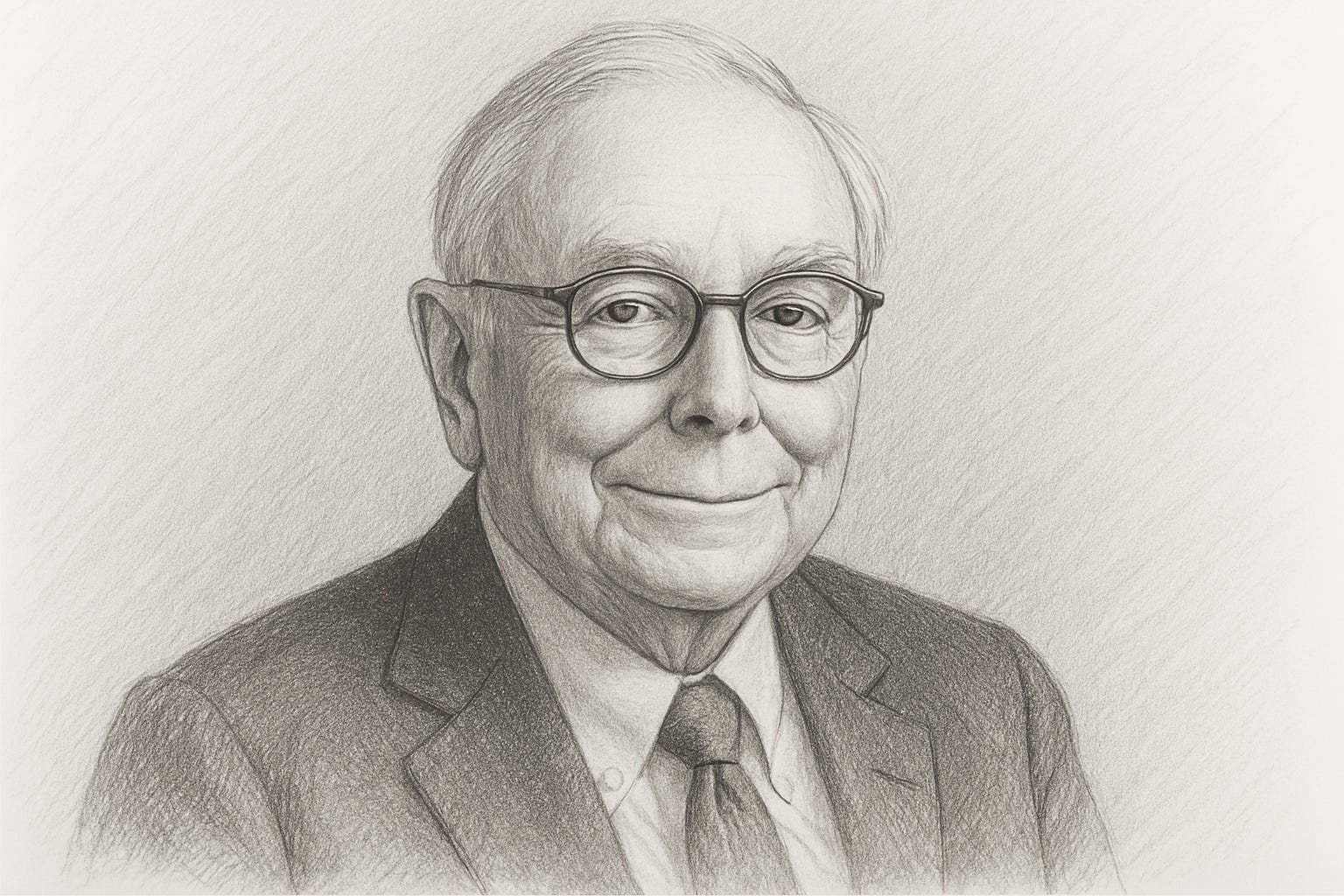
A pencil sketch of Charlie Munger
1. The moment this clicked for me
Look at almost any head scratching situation in life. A school bends its rules. A company makes a strange decision. A team starts cutting corners. A government program sparks a problem it was supposed to solve.
For years I would react with surprise. Why on earth would they do that?
Now, most of the time, I catch myself asking a different question first:
“What were they actually rewarded for?”
Not the official goal on the website. Not the values on the wall. The real incentive. The one that affects someone’s income, status, pride, comfort, or fear.
When you look through that lens, the mystery usually melts away. It becomes obvious. You can almost hear Munger’s voice in the background saying, “Of course they behaved that way.”
This is the cheat code. You follow the incentive. In many cases you literally follow the money. Once you do that, the outcome is rarely surprising anymore.
2. The three step model that explains almost everything
Over time I have boiled this into a simple three step loop. It runs quietly in the back of my mind now.
Step 1: Trace backward to understand what happened
Whenever something feels confusing, I start by asking who benefited and how. I picture a person who is smart, tired, under pressure, maybe a little protective of their paycheck or reputation, and I ask what choice would make life easiest for them.
That alone clears up most confusing behavior.
Step 2: Predict forward from the same incentives
Once you understand the rules of the game, you can see several likely outcomes before they happen. People will always find a way to win the game they have been given. And whenever a rule can be gamed, someone will eventually find the shortcut. It is not about bad people. It is about human nature responding to rewards.
This is where unintended consequences come from. The incentive was visible, but the ripple effects were not fully considered.
Step 3: Decide whether you can live with those outcomes
If the predicted outcomes look unacceptable, the answer is not to lecture people about values. It is to adjust the incentive so the natural behavior lines up with the real goal.
If the incentive remains in place, the outcome is not exactly fixed, but it is close enough that you should plan around it. Good people behaving inside a bad system will still drift toward whatever that system rewards.
3. Two laws that never fail
The more I pay attention, the more two foundational laws reveal themselves.
Law 1: You get what you reward
Reward speed and you will get speed.
Reward volume and you will get volume.
Reward visible metrics and you will get visible metrics.
But you will also get the simplest path to those metrics, which is not always the path you wanted. That is the part people forget.
Law 2: You get the gaming you allow
If a goal is measurable and rewards are attached, someone will eventually discover the easiest way to achieve it. They might even believe they are doing the right thing because incentives quietly shape how we justify our decisions.
This is why Munger talked about “incentive caused bias.” We do not just change behavior. We change our story about what makes sense.
Both laws work in parenting, business, education, public policy, and even your own habits. Once you notice them, you cannot unsee them.
4. How this shows up in everyday life
I used to think this was mainly a business idea, but now I see it everywhere.
Take kids, for example. If I only praise winning, I should not be surprised if my kids start avoiding hard things where they might lose. If I reward honesty, effort, and resilience, I get more of those instead. If they cry and get what they want then they will continue to whine and cry. Their behavior is shaped by what feels safe to admit and what gets positive attention.
Look at workplaces. If leaders reward short term numbers and ignore long term health, teams will find quick ways to hit the metric even if it harms the future. If leaders reward patient progress and craftsmanship, people move in that direction instead.
Look at personal habits. When I track only whether I published a weekly post, I should not be shocked when I find myself rushing some weeks. If I reward myself for thinking deeply and creating something meaningful, the work changes.
Once you understand incentives, you stop blaming character and start redesigning the system. You want to loose weight, then don’t just set the goal, realign your incentives in a way that this outcome becomes probable.
5. A simple checklist for the rest of us
When I look at any goal or habit now, I try to run this short checklist. It helps me catch problems early.
What behavior does this incentive clearly reward?
If someone wanted to game this, how would they do it?
What unintended consequences would appear if this worked perfectly for several years?
What small guardrail could balance this incentive?
Knowing the likely outcomes, do I still want this incentive as written?
If the answer is no, the system needs adjustment. People will simply follow the rules of the game as they understand them.
Closing thought
Munger and Buffett spent almost fifty years shaping Berkshire together, and they built an empire using ideas that were simple enough for anyone to understand yet profound enough to outlast both of them. Of all those ideas, this one might be the most universal.
Show me the incentive and I will show you the outcome.
Show me what someone is rewarded for and I can often tell you how they will behave.
The surprises in life often stop feeling surprising once you use this lens.
You start seeing problems earlier.
You start making better predictions.
And you start designing systems that bring out the best in people instead of boxing them into unintended behavior.
If you remember only one thing from this week’s Five4Friday, let it be this.
Follow the incentive. Follow the money. And let that guide your prediction of what comes next.